You have a story.
Let's turn it into a screenplay.
Every film you love was built on story beats — the moments that make a story work. Professionals plan them before writing a page. BeatBandit puts that craft in your hands: you're the showrunner, the AI is your writers' room, and you decide what stays.
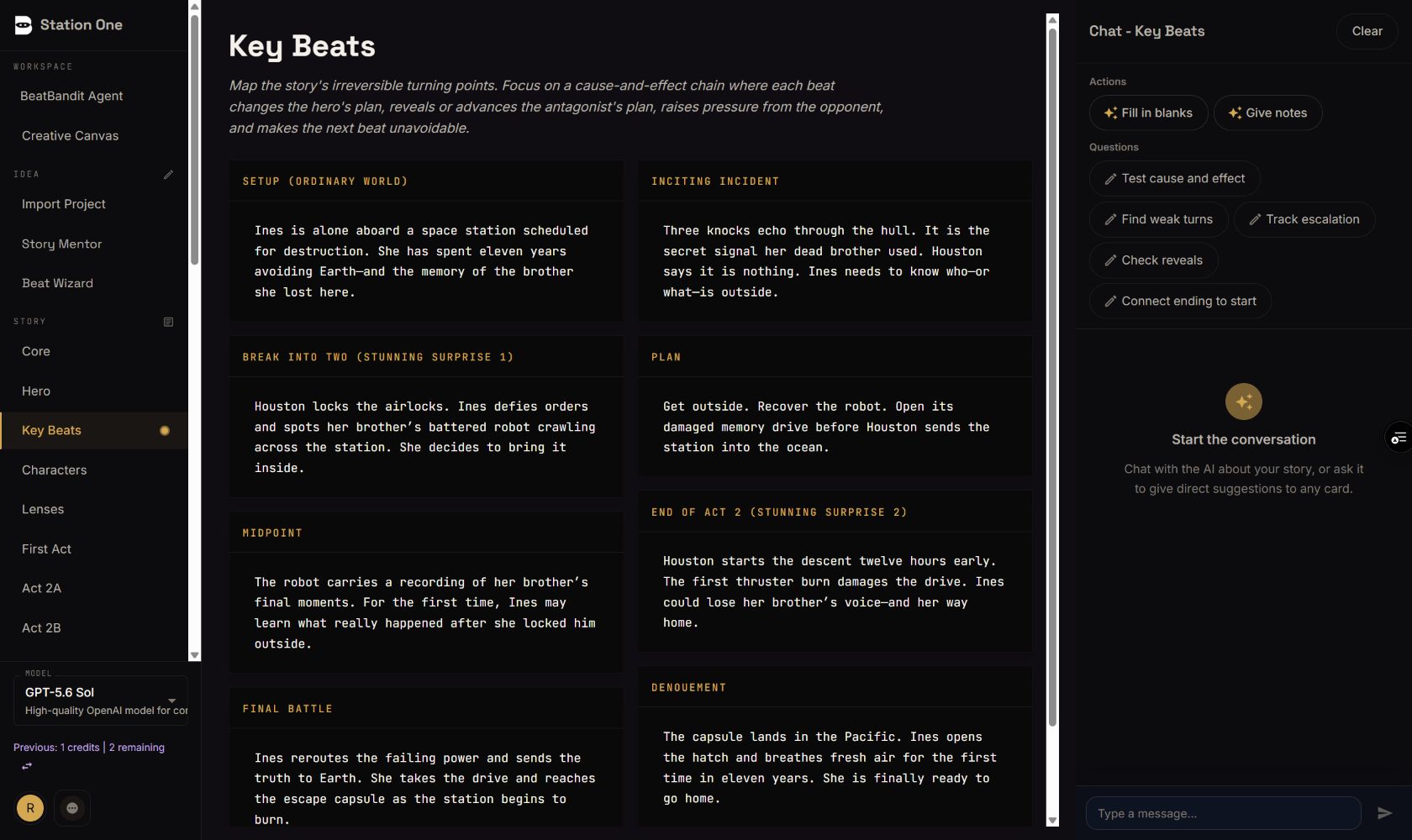
Start with a conversation, not a blank page.
Tell BeatBandit what your story is about. It asks what a writers' room would ask — who wants what, what gets in their way, what it costs them — then drafts your first beats and characters from your answers.
1. Why is she the one still up there?
2. What does she want more than to go home?
3. Who — or what — would know how to knock?
See the whole story at once.
Every story has a handful of big moments — the setup, the thing that changes everything, the point of no return. Those are its beats. Lay them out and you can read, rewrite and rethink the whole story while it's still cheap to change.
Your characters get the same treatment: not just a name, but a wound, a flaw, and an arc.
Not sure what your beats are? The Beat Library maps them in 16 films you already know — the same structures BeatBandit builds from.
Find what's missing. Decide what to change.
In Station One, a sci-fi screenplay, the villain wants the station destroyed but has no personal reason.
Ask what's missing and you get a specific note with its reasoning. Suggested changes wait for your review, current text beside proposed. Apply them, edit them, or let them go.
Suggestion: give Thorne something the burn would erase. If he signed off the budget cuts that sent Tomas outside alone, a clean burn over Point Nemo buries his own mistake — and Ines's drive is evidence.
I've put the change in Working changes.
Beats in. Pages out.
Once your scenes are in place, BeatBandit writes them into properly formatted screenplay pages — following your beats, your characters and your writing voice. Then it's a real screenplay editor: rewrite anything, by hand or with help.
INT. STATION ONE - SOL MODULE - WORKBENCH - CONTINUOUS
The back corner of Sol. A workbench bolted to the wall, a nest of hand tools on yellow tethers turning slowly in the air. Crimpers, a soldering iron, a dog-latch spanner on frayed twine. Coils of obsolete cable held down with bungee.
She navigates a file tree by keyboard. MAINT. LEGACY. T.VASQUEZ. BITACORA.
Scanned notebook pages. Graph paper with oil fingerprints on it. Handwriting that slants hard to the right, in Spanish and English and a mix of both.
She pages through. Wiring runs. A pump schematic with a coffee ring over it. A margin note in capitals:
FLACA: SI EL BUS 3 TE ODIA, PEGALE.
Next to it, a little drawing of a fist.
The corner of her mouth moves. Not quite a smile.
· · ·
A crawler. Four jointed legs with magnetic feet. A squat body. One arm folded up underneath like a mantis, a welding tip at the end. Every part labeled in Tomas's slant. PATA 1. PATA 2. SOLDADOR. BATERIA - ALCANZA? The question mark gone over three times.
Beneath the sketch, written larger and slower than the rest:
A good machine never leaves an open seam.
And under that, just: - T.
Ines stops scrolling.
Her hands come off the keyboard.
INT. STATION ONE - CUPOLA - ORBITAL NIGHT
The edge of the windows goes deep blue. Then orange.
Orbital dawn hits all at once. The camera feed blows out. A solid white rectangle.
The white collapses into shapes. The truss. A rail. Hard black shadow under everything.
And on the rail, something that isn't part of the truss.
A machine. Four jointed legs, feet clamped to the guide rail. A squat body the size of a suitcase, its white paint scorched brown and pitted with tiny black craters. One leg a different color from the others, a replacement. An arm folded underneath the body, its welding tip pressed against the metal.
Ines doesn't move.
It taps the truss. Once. Twice. A third time, a little harder.
A second later it arrives through the Cupola frame, under her left hand.
Knock. Knock. Knock.
MARCUS (V.O.)
Ines, we're showing EXT-4 moving. Nobody down here commanded that.
Her eyes go to the comm key on her vest. Her hand drifts toward it. Stops.
BeatBandit handles screenplay formatting as you type. Export to PDF, Final Draft or Fountain whenever you like.
Next to every scene: what it's for. The beats it serves, what the character wants, where it turns. Most screenwriting software shows you only the page.
The line under Tomas's sketch comes straight from the Meeting the Mentor beat. Beats, characters and pages live in one project — what you plant, the pages remember.
Change your mind without starting over.
Decide that Marcus, the flight director, was the one who told Ines to close the hatch eleven years ago. Revise finds every beat, character and page that changes, and shows each one before and after. Apply what you like, dismiss what you don't.
Don't take our word for it. Read the pages.
Each of these started as a line or two. Here's the brief, and the full screenplay it became.
"Station One, the first commercial space station, is being shut down after 22 years and will be crashed into the ocean at Point Nemo. Its last occupant is Ines Vasquez, 54, the chief engineer, who volunteered to do the 30-day shutdown alone. Eleven years ago her younger brother Tomas died outside the hull during an accident — Ines was the one who sealed the airlock with him still outside, to save the rest of the crew. She has kept the station running ever since. A few days before she's due to leave, she hears three knocks on the hull, the way Tomas used to knock on her door when they were kids. Ground control thinks she's cracking. What's knocking is the maintenance robot Tomas built, which everyone thought was destroyed in the accident. It has been crawling around the outside of the station for eleven years, repairing it under Tomas's orders — and it holds a recording of what Tomas said while she closed the door. Sci-fi drama, eerie and tender, about letting go."
More on the Samples page →
INT. STATION ONE - CUPOLA - ORBITAL DAY
Silence.
Then, under it, the slow mechanical breath of an air scrubber. Push. Pause. Push.
A red grease pencil drifts across a scratched viewport. Beyond the glass, the blue curve of Earth. Cloud moving over open water, four hundred kilometers down.
A hand comes up and closes around the pencil. Nobody looked.
A chat remembers a conversation. BeatBandit remembers a story.
A chat window gives you one answer at a time. BeatBandit keeps your beats, characters and pages together, so every suggestion knows the whole story — and lands where it belongs.
The AI suggests. You decide.
Every beat and character is yours to edit directly — it saves as you type. Suggestions arrive as proposals. Earlier versions are one click away. Use as much help as you want, or none.
Your story is yours. Nothing you write is used to train AI models. Export it all — PDF, Final Draft, Fountain — any time.
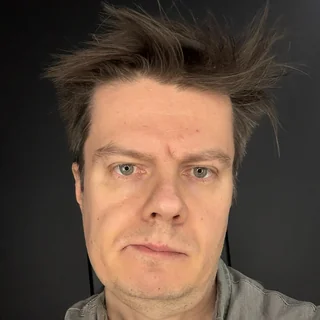
"I built the tool I wanted as a writer: one that hands me structure and gets out of the way when the words come."
No subscription. Pay for what you write.
Buy credits for AI help when you need them. Writing and editing by hand are free. See the prices and a real project's usage on the pricing page.
Pay per use. Credits never expire.
- No subscription, nothing auto-renews
- See the price before every AI action
- One balance covers every stage
The short answers.
I've never written a screenplay. Is this for me?
Yes — that's exactly who it's built for. You bring the story. BeatBandit walks you through the beats professionals use, explains its suggestions, and handles the formatting.
Will it sound like generic AI?
Read the samples and judge for yourself. Pages are written from your beats, characters and chosen writing voice, and you can rewrite anything.
Do you own or train on my work?
No. Your story is yours, and nothing you write is used to train AI models.
I already have a script. Is this useful to me?
Import it and get notes, story-wide revisions, and a shot list from your existing pages.
Which evil corporation is behind this?
None. BeatBandit is built by an independent writer-developer.